History
Ten instants from the history of Santorini
Everybody knows her, everywhere they talk about her, they all dream of her one way or another and wish to enjoy a sunset in the caldera. However, Santorini has a great lot to tell us. Let us listen to her...
- Santorini emerges from the depths of the sea and is called ‘Strogili’ (round, in Greek) because of her shape. In the third millennium B.C. a city with an important port develops at Akrotiri. Following a period of major development, an earthquake (late 17th c.) totally destroys the city. We have the opportunity to admire the wall paintings of the new rebuilt city at the museum of Pre-historic Thira.
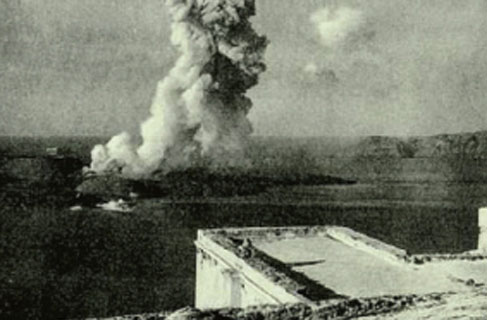
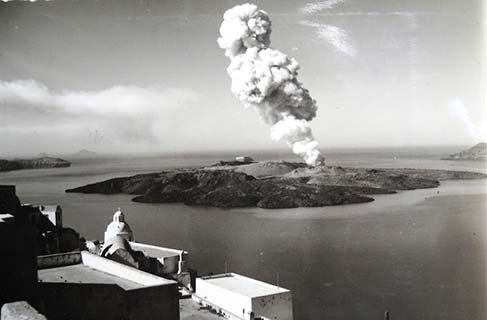
- The big volcanic eruption of the Later Bronze Age (approximately 1600 B.C.) burries everything. What remains is just three stripes of land of huge geological interest (the big part with the caldera, Nea Kameni and Thirasia), which are unique and well-known all over the world.
- In the late13th c. B.C. Santorini is re-inhabited by the Phoenicians and later on by the Lacedaemonians (9th c. B.C.), who gave her the name “Thira”. During this period, Thira has achieved no significant cultural development, except for the foundation of a colony named Kirini and the adoption of the Phoenician alphabet in the 8th century B.C.
- The Ptolemies use Thira in the Hellenistic Times as their headquarters during war, whereas in the Roman Times Thira completely ‘vanishes’ from the map.
- In the Byzantine Times (after having been christianised since the 4th c. A.C.) Alexios A΄ Komninos founds the Church of Panagia Episkopi (11th c. A.C.), which is still standing today imposing in Mesa Gonia.
- Following the Crusades, Thira is granted to Markos Sanoudos (1204) and gets integrated in the Duchy of the Aegean Sea. The Venetians are the ones who give her the name “Santorini”, deriving from “Santa Irini”, the italian name for the Church of Saint Irene. Rivalries between the Latin conquerors and pirates plague Santorini.
- During the Turkish Occupation (1579-1821), Santorini develops commercial activity with the ports of the Eastern Mediterranean. Then follows economic and cultural growth, which accelerates after the Treaty of Küçük Kaynarca (1774), according to which the merchant vessels of Santorini could sail in the Mediterranean Sea under the protection of the Russian flag.
- The integration of Santorini to the newly-established Greek State (1830) signals a new period of commercial and shipping prosperity.
- In the 20th century Santorini comes to a decline following the World Wars. The devastating earthquake of 1956 leads to her desertification.
- The development of tourism, initiating at the end of the 70s, will bring her back to the light of cosmopolitan life, where she belongs. And the name of hers ‘Kallisti’ (‘the Most Beautiful’)!