Santorini Sights
Oia village
Santorini island guide
ABOUT SANTORINI
FOOD AND WINE
ENTERTAINMENT
ACTIVITIES
ACCOMMODATION
INFO
MAPS
SHOPPING & SERVICES
<a href="http://www.macromedia.com/go/getflashplayer">Flash Required</a>
Flash Required
<a href="http://www.macromedia.com/go/getflashplayer">Flash Required</a>
Flash Required
Santorini
Oia Confidential!updated
Although a tourist spot, Oia remains an exceptionally artistic, hardly touched site; it is the part of the island least affected by tourism. A model of architecture, finesse and charm, Oia has its own fanatic followers: those who know how to appreciate what is different and unique!
Present-Day Oia

Quiet yet cosmopolitan, Oia is chosen by those who seek serenity, calmness and luxury in their holidays. This is why here are some of the best places to stay on the island, as well as luxurious restaurants, exquisite galleries and a wide range of shops. We have wandered around its alleys, chatted with its people and share with you all those features that make it stand out!
History
In the Middle Ages (1335), Oia was one of the castellos, the fortresses, of the island erected by the Venetians; it was called “Aghios Nikolaos’ Castle” or “Panomerea” (the Upper side). The district was handed over to the nobility family of the Dargentas, who were Latinized Greeks. In order to be protected from pirate invasions, they built a tower with an observatory, called “Goulas”. This tower included all residences, the greatest of all belonging to the Castellan of Panomerea (Duke Dargenta). In 1579, the site passed to the Ottomans for 250 years; during this period it suffered numerous
pirate raids. In 1650, an eruption of Koloumpo, an undersea volcano, destroyed the region. After 1850, its residents, the Panomerites, who were great sailors, returned to the activity they were renowned for: 165 sailing ships criss-crossed the Aegean, the Mediterranean and the Black Sea carrying famous Santorini wine. After the end of the Ottoman Occupation (i.e. after 1830), the regional economy flourished. It was then that Pano Meria (the Upper Side) changed its name to Oia; it had already become a small residential centre with 2.500 inhabitants. The architectural masterpieces being restored today date back to that glorious historical period.
What is Oia?
“Sea-wakened, proud / you lifted up your stone breast / speckled with the southwind’s inspiration / for pain to inscribe its very heart there. / For hope to inscribe its very heart there” (Trans. by Jeffrey Carson & Nikos Sarris). These were the words through which the great Greek poet Odysseas Elytis expressed his feelings for Oia in his poem “Ode to Santorini”.
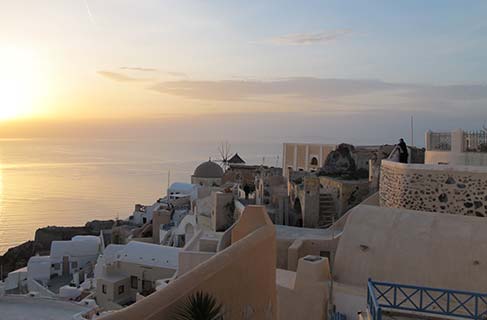
The traditional village of Oia –a listed monument–  unfolds along the volcanic rocks; it is the jewel of Santorini! Adored by everyone for its eternal exquisite beauty and unforgettable sunsets, Oia seduces visitors her picturesque yposkafa, i.e. residences carved into the rock, narrow paths and imposing Caldera. “It is Oia that has made me wiser and helped me improve my humble perception of aesthetics; it taught me the art of subtraction, or rather non-addition, the value of harmony and the human scale” says fashion designer Yannis Tseklenis, in reference to the uniqueness of Oia.
The past & the present

Oia lies at the northermost part of the island, 11 km northwest of Fira, at an altitude of about 121 metres.
The residential complex of Oia was the first one in Greece to be listed as an architectural monument (in 1976 by EOT/ Hellenic Tourism Organisation); it was integrated into the Programme for the Development of Traditional Hamlets. Oia is divided into two sections by a central road (Nomikos Street): one faces the Caldera and the cliff and it is where the yposkafa residences are, while the other contains “conventional residences”, the so-called kapetanospita (Captains’ Homes). The yposkafa are carved in the volcanic rocks and used to be where ship crew members lived. On the other hand, kapetanospita used to be ship owners’ homes; in other words, they belonged to middle-class members. The morphology of yposkafa was determined by local materials and the use they were put to. Today Oia Community includes: Oia, Finikia, Tholo, Armeni (small bay), Ammoudi (small port), Mavri Petra (Paradisos), Koloumpo and the islet of Thirasia.
Churches & Districts
“This is where the beautiful and the pure emerged to become rock sculpture; this is where the colorful sculpture of innocence stemmed from” writes Kadio Kolymva, a writer from Oia, referring to the landscape.
A typical feature of Oia is its 70 small and big churches and its districts, each one with its own historical particularities. The first district one goes through at Oia is Perivolas, with St. George’s Church. Walking along the central marble-paved street with the two large church domes (St. Spyridon and Ressurection Churches), we come to the district called Monastiri (due to the numerous chapels in it). The downhill street leads to Armenaki, while next to Monastiri lies the district of Lotza. Then follow Goulas and Vounaras districts. Getting to Oia from the road below, we come to Sideras with its magnificent mansion-like kapetanospita. The earthquakes of 1928 and 1956 destroyed a large part of this unique residential complex.
The people of Oia
People who have significantly contributed to the revival and preservation of this unique settlement:

• Aristidis Alafouzos, ship tycoon, of Alafouzos family, well-known since the 19th century. He has donated two desalination plants to Oia Community.

• Shipowner Loukas Nomikos paved the main street of Oia (Nomikos Street) with marble in the 19th century, while Captain Antonis Dakoronias housed for the first time the famous Maritime Museum of Oia at his grandfather’s Minas Nomikos’ residence (today the Museum is housed at the kapetanospito of Dina Manolessou-Birbili).

• Dimitris Nomikos is the President of the Maritime
Museum of Oia. He also supports Oia financially through scholarships and participates in the construction of Nomikos Cultural Center. The Square in front of Panagia Platsani Church is called Nomikos Square, to honor the Nomikos Family.

• Kadio Kolymva has honored Oia in her books
“The Upper Side of the World”, “Route of the South Wind”, “Oia” (Armos Publications). She eloquently
presents every single aspect of her homeland.

• Georgios Halaris, current President of Oia Community, does his best to preserve its traditional color.
*Within the context of EOT Programme for the Development of Traditional Hamlets, architects An. Zervas and Par. Bozineki, received an award (1979) for their wonderful “remodeling” of the old settlement of Oia, transforming it into a tourist area while preserving its authenticity.

www.santorini-islandguide.com 2008 - 2010.All rights reserved.Reproduction, copy or any kind of use without the written authorization of the rightful owner is prohibited and will be prosecuted.
What not to miss in Oia
Shopping in Oia
Santorini Oia restaurants
Mirabo Luxury Villas